The Yang Family's Women Generals (Yang Men Nu Jiang)
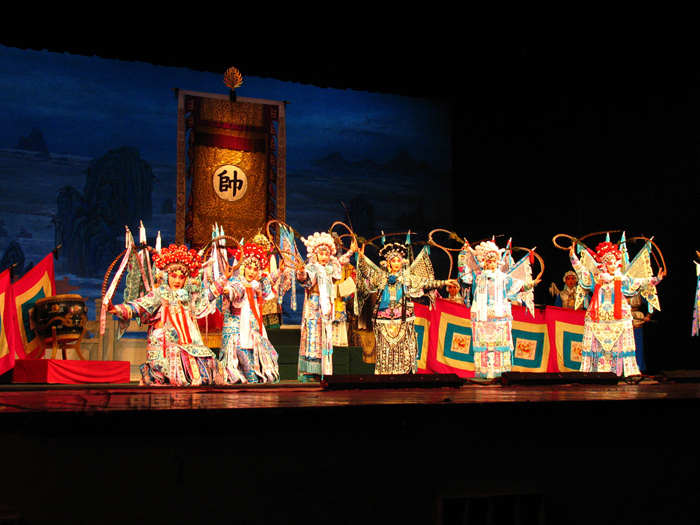
Overview. The Yang Family's Women Generals was written in 1960 by Fan Junhong, drawing on the Yangzhou opera A Centenarian Takes Command, with an enriched plot. It was performed by the young actors of the Fourth Troupe of the China Peking Opera Theatre — Yang Qiuling, Wang Jinghua, Feng Zhixiao — and filmed.
Synopsis. During the reign of Emperor Renzong of the Song, the Western Xia king raises an army to invade the border. The Song commander Yang Zongbao, guarding the frontier, leads his troops against the enemy but is fatally shot by a stray arrow while scouting a narrow pass, the Gourd Valley. In the emergency, the sons of Meng Liang and Jiao Zan return to court for reinforcements. The two generals arrive at the Tianbo Residence, where the centenarian She Taijun is hosting a feast for Zongbao's fiftieth birthday. The terrible news arrives; the household is plunged into grief and the court into shock, and some would cede territory for peace. She Taijun, suppressing her sorrow, leads her widowed daughters-in-law, grand-daughters-in-law, and great-grandson Wen Guang, and sternly refutes the court's appeasers. The aged matriarch takes command and leads the Yang women to the frontier to resist the enemy and save the state. The young Yang Wenguang pleads to go; his mother Mu Guiying wishes her son to fight, but his grandmother Princess Chai, fearing the Yang house has only this one boy, forbids it. She Taijun orders Mu Guiying and her son to duel in the drill ground to decide who goes. With Mu Guiying's secret yielding and Seventh Lady's prompting, Wenguang defeats his mother with the plum-blossom spear and wins the right to march. On the field the Western Xia king is defeated and retreats to his old camp, holding the natural stronghold and devising a trap to lure Wenguang into the valley and threaten the Yang house. The plan is seen through by She Taijun and Mu Guiying. From Yang Zongbao's dying words about the valley path and the account of the groom Zhang Biao, they confirm a plank road does exist within the valley, by which the heavenly precipice may be crossed to surprise the enemy camp. Mu Guiying asks to turn the trap to her advantage and enter the valley. She Taijun gives Zongbao's White Dragon horse to Wenguang to fortify his mission. After entering the valley, Mu Guiying, her son, and Seventh Lady traverse the peaks, enduring hardship and setbacks, and at last, guided by an old horse that knows the way and helped by a herb-gathering elder, climb onto the plank road. Just then the Western Xia king has surrounded the valley mouth, threatening She Taijun: surrender the border or he will set the valley ablaze. The matriarch does not flinch. Suddenly enemy camp fire flares to the sky — the signal that Mu Guiying has crossed the peril — and She Taijun leads her troops in a fierce charge, attacking from within and without, annihilating the Western Xia army in one stroke.
Artistic Features. A grand and solemn epic, a stirring and beautiful national symphony. The film preserves the original stage Peking Opera character while giving full play to the strengths of cinema for a powerful screen-dramatic effect. In rendering the characters' shifting emotions, the film aptly controls the movement of near and far, long and short shots and the pace of cuts, delicately presenting their complex inner states. In set design it pursues an elegant, simple, and indeterminate effect, evoking the mood of Chinese ink painting. The cinematographer, in the handling of light, color, composition, and modeling, also strives for a meticulous yet gorgeous, bright, and brisk national character.
Why Watch. The Yang Family's Women Generals is a monumental patriotic epic of the Yang clan's loyalty across generations, a flagship modern classic of the Peking Opera stage.
猜你喜欢

Rickshaw Boy (Camel Xiangzi)
2026-10-15
Yang Jingyu (Yang Jing Yu)
2026-10-15
The Red Lantern (Hong Deng Ji)
2026-10-15
Plaster Zhang (Gao Yao Zhang)
2026-10-15